Core Web Vitals for Business Websites: The 2026 Guide
LCP, INP, and CLS in plain terms: what Google measures, what passing scores look like, and the three fixes that move them most.
Your B2B website might be quietly draining your pipeline, and the cause is usually mundane: the three seconds your homepage takes to load, not your messaging or your sales team.
Google’s Core Web Vitals are now a baseline requirement for search visibility, not a technical nice-to-have. Fail them and the damage runs past rankings into revenue. Here is what changed in 2026 and what to fix first. The current passing thresholds: LCP under 2.5 seconds, INP under 200 milliseconds, and CLS under 0.1.
What are Core Web Vitals (and why should you care)?
Core Web Vitals are three specific metrics Google uses to measure how real people experience your website. They’re based on actual visitor data from Chrome browsers rather than abstract lab tests, and they directly influence where you appear in search results.
The three metrics measure different parts of the experience:
Largest Contentful Paint (LCP) measures how long it takes for the main content on your page to become visible. Think of it as the moment a visitor stops staring at a blank screen and starts reading your value proposition. The target is under 2.5 seconds.
Interaction to Next Paint (INP) measures how quickly your site responds when someone clicks a button or fills out a form field. INP replaced First Input Delay (FID) in March 2024, and it’s far more demanding because it tracks every interaction throughout the entire page visit rather than only the first. The target is under 200 milliseconds.
Cumulative Layout Shift (CLS) measures visual stability. If your page content jumps around while loading, with buttons shifting and images popping in, that’s a high CLS score. The target is under 0.1.
Google evaluates these using the 75th percentile of field data, meaning 75% of your real page visits need to pass for your site to earn a “good” rating.
What changed in 2026
The thresholds themselves haven’t shifted, but the stakes have risen considerably.
Real-world data carries more weight
Google has increased its emphasis on field data, meaning how actual users experience your site on their own devices and networks, over lab-based testing tools like Lighthouse. A perfect score in a controlled test environment means very little if your visitors in Maryville are loading your site on a three-year-old phone over an LTE connection.
This shift matters for B2B companies with regional audiences. Your East Tennessee prospects aren’t all browsing on fiber-connected MacBook Pros. Performance needs to hold up across the full spectrum of devices and connections your buyers actually use.
Mobile performance is non-negotiable
Mobile-first indexing has been the standard for years, but 2026 has brought even sharper emphasis on mobile Core Web Vitals scores. With over 60% of web traffic coming from mobile devices, Google is weighting mobile performance more heavily in rankings.
For B2B, this is a wake-up call. Many B2B sites are designed desktop-first, with mobile treated as an afterthought. That approach now carries a measurable SEO penalty.
AI search demands fast, reliable sources
AI-powered search experiences, including Google’s AI Overviews and other answer engine optimization platforms, prefer fast, stable websites as citation sources. When an AI model is deciding which pages to reference in a generated answer, it favors sites that load quickly and render reliably.
Fast pages allow crawlers to retrieve and process information more efficiently. Stable websites reduce the risk of errors during content extraction. A sluggish site loses traditional search rankings and becomes invisible to the AI search layer that’s rapidly consuming organic traffic.
Thresholds may tighten soon
While current benchmarks remain stable, Google has been experimenting with tighter standards. The INP “good” threshold could drop from 200ms to 150ms as browser capabilities improve. New metrics around scroll stability and interaction smoothness are also under development. Getting ahead of these changes now gives you a buffer when thresholds shift.
Why performance equals pipeline
The numbers are where most B2B leaders’ eyes glaze over on “technical SEO” topics, and where they shouldn’t.
Rankings and visibility
Core Web Vitals are a tiebreaker in Google’s ranking algorithm. When two pages have comparable content quality and E-E-A-T signals, the faster, more stable page wins. In competitive B2B niches, where content quality among serious players is often similar, this tiebreaker effect becomes significant.
Sites passing all three Core Web Vitals thresholds see approximately 24% lower bounce rates and measurably better organic positions.
Conversions and lead quality
The average B2B website converts just 1.8% of visitors into leads. That’s already a thin margin. Now consider that a one-second delay in page load time can reduce conversions by up to 7%. On a site generating 10,000 monthly visitors, that’s the difference between 180 leads and 167 leads every single month.
Compound that over a year, and slow performance is silently draining hundreds of potential opportunities from your pipeline. For B2B companies where a single closed deal might be worth $50,000 or more, even a handful of lost conversions translates to real revenue impact.
The trust factor
There’s a psychological dimension here too. When a B2B buyer visits your site and the page takes four seconds to load, elements shift around on screen, and buttons don’t respond immediately, what message does that send about your company? In an industry where credibility and reliability are everything, a slow website erodes trust before your prospect reads a single word of copy.
The three-step optimization playbook
You don’t need to overhaul your entire technology stack to improve Core Web Vitals. This prioritized approach delivers the fastest results.
Step 1: Fix LCP first (loading speed)
LCP failures are almost always caused by images. The hero image on your homepage and the banner on your landing page are typically the largest contentful elements, and they’re usually unoptimized.
Quick wins:
- Convert images to modern formats like WebP or AVIF, which can reduce file sizes by 25-50% with no visible quality loss
- Add responsive images with
srcsetso mobile devices don’t download desktop-sized files - Preload your LCP image in the HTML
<head>so the browser fetches it immediately - Deploy a CDN to serve assets from servers geographically close to your audience
- Set up caching strategies so returning visitors load content fast
Infrastructure moves:
- Move to a static site generator or headless CMS architecture that serves pre-built HTML from the edge
- Optimize server response times; your time to first byte (TTFB) should be under 800ms
- Inline critical CSS so above-the-fold content renders without waiting for external stylesheets
Step 2: Eliminate CLS (visual stability)
CLS has the highest pass rate of the three metrics because the fixes are straightforward. Every image, video, iframe, and ad slot on your site needs explicit width and height attributes so the browser reserves the correct amount of space before the element loads.
Key fixes:
- Add dimension attributes to all media elements
- Use
font-display: swapin your CSS and preload web fonts to prevent text from reflowing - Reserve space for any dynamically loaded content; chat widgets, cookie banners, and third-party embeds are common offenders
- Avoid inserting content above existing content after the page has started rendering
Step 3: Tackle INP (responsiveness)
INP is the hardest Core Web Vital to pass. In 2026, 43% of websites still fail the 200ms threshold. The root cause is almost always JavaScript: too much of it running too long on the browser’s main thread.
Optimization strategies:
- Audit your JavaScript bundle and remove anything unnecessary; every WordPress plugin, analytics tag, and third-party widget adds main thread work
- Break long-running JavaScript tasks into smaller chunks that yield back to the browser
- Defer non-critical scripts so they don’t compete with user interactions
- Reduce DOM complexity; pages with thousands of nodes take longer to update after each interaction
- Use Chrome DevTools Performance profiling to identify exactly which interactions are slow and why
How your CMS choice matters
Your content management system has a large impact on Core Web Vitals potential. Modern static site generators like Astro deliver pre-rendered HTML directly from the CDN and hit near-perfect LCP scores by default. Traditional CMS platforms like WordPress require significant optimization effort, plus a growing list of plugins, to approach the same performance levels.
If your current site is built on a legacy CMS loaded with plugins, each one adding JavaScript and database queries, you are working against the architecture itself. Sometimes the most cost-effective path to passing Core Web Vitals is migrating to an architecture designed for performance from the ground up rather than optimizing what you have.
Make monitoring an ongoing habit
Passing Core Web Vitals once isn’t enough. Every new plugin or third-party integration can degrade your scores. Build continuous monitoring into your operations:
- Google Search Console provides a Core Web Vitals report based on 28 days of real user data; check it monthly at minimum
- Set alert thresholds at 80% of Google’s limits (LCP > 2.0s, INP > 160ms, CLS > 0.08) so you catch regressions before they impact rankings
- Test before deploying: run Lighthouse CI in your build pipeline to catch performance regressions before they reach production
- Monitor by page type: your homepage, key landing pages, and highest-traffic blog posts each deserve individual attention
What this means for your growth strategy
Core Web Vitals are more than a technical SEO metric. They signal how seriously you take your buyers’ experience. In 2026, with AI search reshaping how prospects find vendors and mobile performance carrying more ranking weight than ever, website speed and stability have become foundational to B2B growth.
The good news: most of your competitors haven’t caught up. Only about 48% of mobile site visits pass all three Core Web Vitals thresholds. That gap is your opportunity.
Start with a performance audit to understand where you stand. Prioritize LCP fixes for the quickest wins. Build monitoring into your workflow so improvements stick. And if your current technology stack is fundamentally limiting your performance ceiling, consider whether a platform migration might deliver better long-term ROI than endless optimization patches.
Your website is the center of your demand generation engine. Make sure it’s not the bottleneck.
Proof in practice: TW Carbon
Want to see what this looks like in the real world? Our work with TW Carbon shows how performance and technical foundation improvements can drive measurable growth:
- Sessions: 1,531 in August 2026 against 862 in August 2025, up 78% (GA4).
- Search: average Google position moved from 28.6 to 13.0, Q2 2026 against Q2 2025, on 30% more impressions (Search Console).
- Leads: 47 quote requests in August 2026, up from 25 in June, each traced to the page it came from.
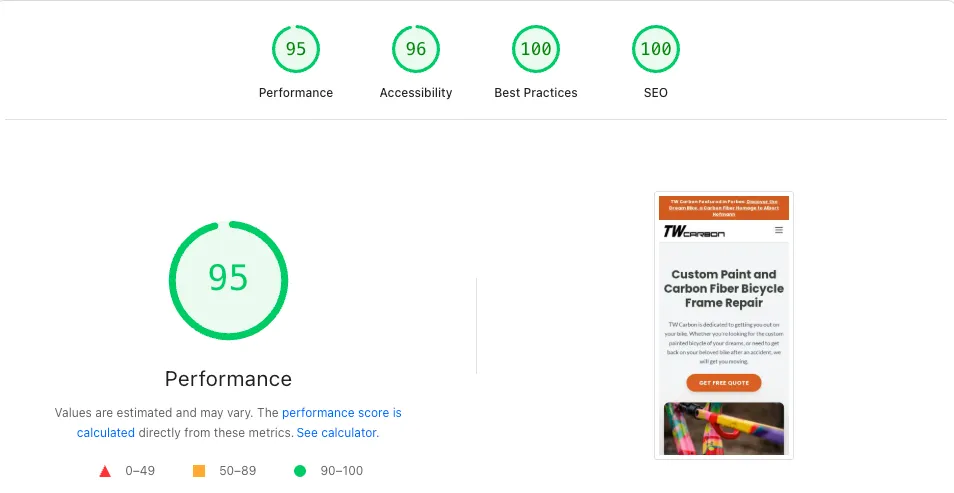
See the full TW Carbon case study and how I turned technical improvements into pipeline impact.