Website designer in Maryville, TN
Maryville web design, priced on the page, built to make the phone ring.
I build hand-coded websites for Maryville businesses: no WordPress, no page builders, every site static and served from the edge. The price is on this page: $500 a month with the local SEO work included, $0 upfront.
Who this page is for
You run a Maryville business and you are comparing the $50-to-$200-a-month subscriptions against project quotes in the thousands. You want the price before the call, and it is below.
It is written for the businesses I actually build for: contractors and trades, offices and practices, restaurants, and shops around Blount County whose customers find them on a phone. If you are a national brand shopping for an agency of record, I am the wrong size on purpose.
If what you need is rankings and calls rather than a website by itself, start with local SEO in Maryville instead; the $500 plan covers both and this page explains how they fit together.
What your site will look like
There is no theme underneath these sites, so there is no theme look. Layout, color, and type get decided by your business: what you sell, who buys it, and what they need to see before they call. A drainage contractor's site should look like the finished yards and the trucks. An estate attorney's should look like the letterhead. Neither should look like the other, and neither should look like the 4,000 other businesses that bought the same $59 template.
Every build starts with a small design system: your colors if you have them, chosen for you if you don't, one heading face and one body face, and a fixed set of buttons, cards, and spacing rules. It is written down and reused on every page, which is why page six looks like it belongs to the same company as the homepage. When you add a service page two years from now, it still will.
The raw material is your actual business. Real photos of real jobs beat stock photography every time, and I will tell you which six photos to go take with your phone if you don't have them. What I will not do is fill your site with lifestyle images of models shaking hands. Nobody in Blount County believes that person installed your gutters. The case studies walk through real engagements, the decisions behind them, and where the numbers came from.
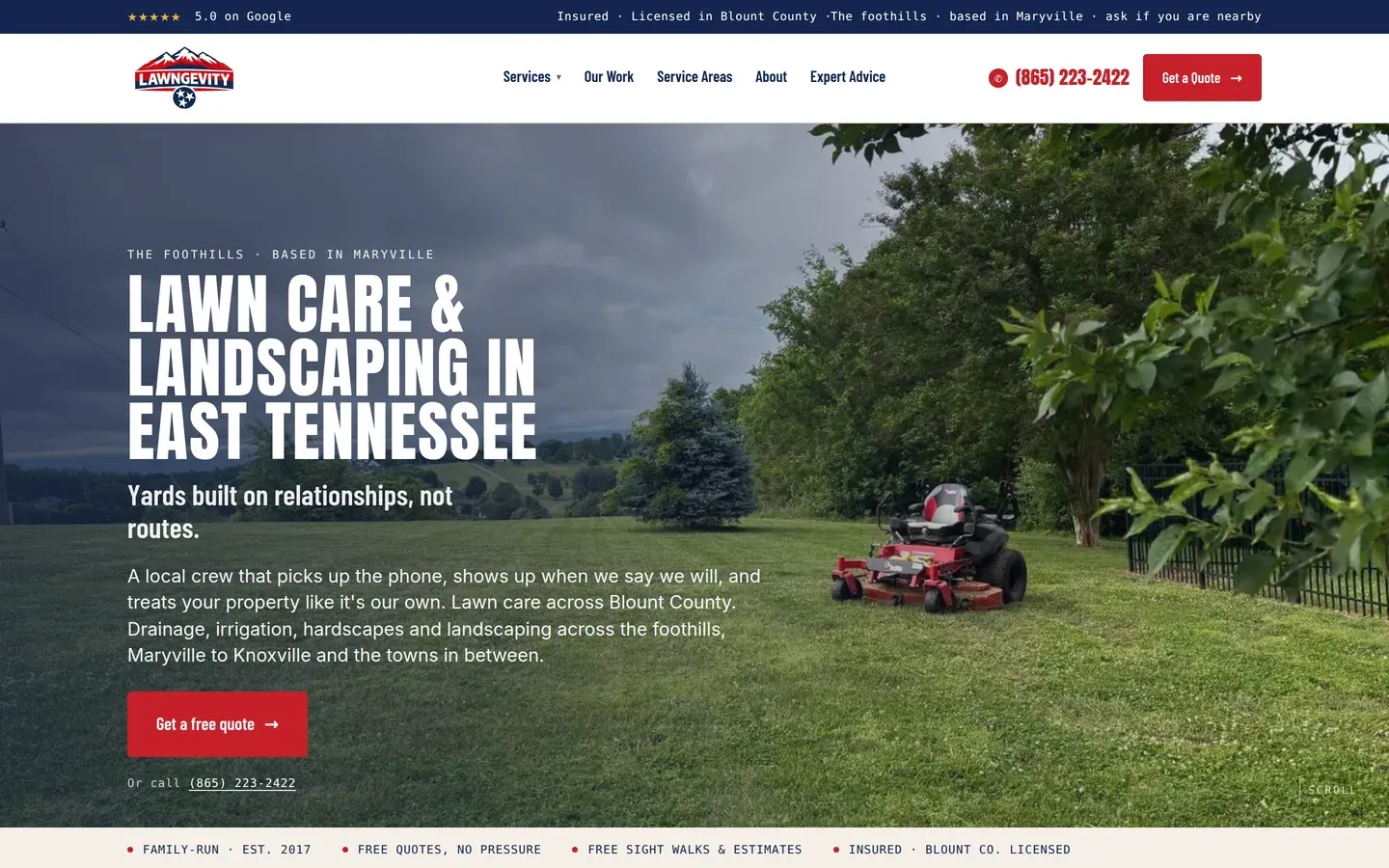
Lawngevity, a Maryville landscaping company, live since June 2026. Clicks from Google went from 12 in the three months before the relaunch to 113 in the three months after. Read the case study
Design decisions that produce phone calls
On a local service site, most design decisions are conversion decisions wearing nicer clothes. The ones I make on every build: the phone number sits in the header, the footer, and a tap-to-call bar on mobile, because the whole site exists to make that tap happen. Each screen asks the visitor to do one thing, not five. Proof sits next to the ask: the review quote and the license number live beside the call button, not on an About page nobody visits. Forms ask for a name, a number, and what the job is, because every extra field costs you a nervous first-time caller.
Type is set for a 55-year-old reading a phone in a truck, not for a design award. And the layout is built mobile-first because that is how your customers actually arrive: for most Maryville service businesses I've measured, well over half of visits are phones.
None of this is taste. Once the site is live I check which pages produce forms and calls, and when a design decision doesn't earn its place, it gets changed. That is the difference between design as decoration and design as the thing that makes the phone ring.
What hand-coded means for a Maryville business
Every site I build is written as code, built on Astro, and served as static files from Cloudflare's edge network. There is no WordPress install underneath, no theme, no plugin stack, and no database.
That choice is where the speed comes from. A page with nothing to assemble has less to load than a page built on a CMS with a plugin stack on top, and that matters twice: Google folds page experience into ranking, and a Maryville customer on a phone in a parking lot will not wait around for a plumber's site to paint. It is also where the maintenance bill goes away. No plugins means no update treadmill and no plugin vulnerabilities to patch on a Sunday.
I wrote up the full technical comparison in Astro vs WordPress in 2026. The short version: a template CMS is the right tool when a team of editors publishes daily. A local service business needs a fast brochure that converts, and hand-coded wins that job.
The speed test, run on Maryville's own web designers
A web designer's homepage is the one site they had complete freedom to make fast. So I ran Google PageSpeed Insights, mobile, on the homepage of every web design company ranking for Maryville searches, on Aug 12, 2026.
| Company | Mobile performance | Largest Contentful Paint |
|---|---|---|
| Better Off Growth(us) | 94 | 1.9 s |
| Wild Heart Design | 60 | 8.0 s |
| Orvani | 93 | 2.7 s |
| Forty-Second Street | 40 | 26.7 s |
| Climb Club | 56 | 22.7 s |
| Smoky Mountain Web Design / Scott Botkins | 94 | 3.1 s |
| Allevia Technology | 28 | 9.6 s |
Smoky Mountain Web Design's own domain now redirects to a Scott Botkins-branded URL and returned identical results, so the two are listed as one row rather than padded out as separate competitors.
Run the same test yourself at pagespeed.web.dev, on any of these sites and on your own. It is free and takes a minute per site. Whatever a sales page claims, the score is the score.
The reason to care is money. Speed decides how many of the visitors you already paid for, through ads or through months of SEO work, stick around long enough to call. Google's published Core Web Vitals threshold sets 2.5 seconds as the ceiling for a good Largest Contentful Paint (web.dev, checked August 2026). One homepage in that table clears the bar today: ours, at 1.9 seconds. Orvani comes closest among the rest at 2.7 seconds, the Botkins operation runs 3.1, and the others are well behind. A homepage is the site a designer had complete freedom to optimize, so treat every number in that table, including mine, as a starting point to verify rather than a settled score.
One price: $500 a month, local SEO included
Digital Foundations
$500 /mo
The hand-coded build, hosting and ongoing updates, plus the local SEO work that gets it found.
- Hand-coded site, hosting, security, unlimited updates
- Google Business Profile, reviews, citations
- A new page or post every month
- Quarterly check-in on what came in
$0 upfront, 12-month term. If you need to leave early, the contract sets out how, in writing before you sign.
Against the market: two distinct local operations publish $50 and $195 a month (their sites, checked August 2026); Smoky Mountain Web Design and Scott Botkins are the same business, so that pair counts once. Cheaper, and worth asking four questions about before you sign. What happens to the site when you cancel? Who owns the domain? What does any included "SEO" concretely consist of? Who pays when the platform underneath needs fixing? To their credit, Orvani's homepage states clients own the site after 12 months (their site, August 2026), and Botkins' Maryville page states its 12-month minimum plainly (his site, August 2026). For anyone else, get the ownership answer in writing. What web designers charge more broadly, and why quotes vary so much, is in how much web designers charge.
How web design pairs with local SEO
A fast site is the floor. Ranking in the Maryville map pack is a separate job: profile management, review velocity, citations, and pages targeting the searches Blount County residents type. It is included in the $500, because for most service businesses it is the half that produces the calls.
The Maryville SEO page covers that work in detail, including the current pack review counts, and how to rank higher on Google Maps explains the mechanics. The local SEO service page covers the package itself.
How the build works
We start with a call about your business: what you sell, what a good customer is worth, which jobs you want more of. I write and build from that, and you review the site on a live preview link, on your own phone, before anything ships.
Launch includes redirects from your old URLs so whatever Google standing you have carries over instead of getting torched. A typical service-business site goes from kickoff to launch in 4 to 6 weeks.
After launch, updates are included. A price change or a new service page: text me and it gets done. You have my cell number, and there is no ticket queue because there is no staff. When something needs attention on a Friday afternoon, you are texting the person who wrote the code.