SEO and content for East Tennessee service businesses
Pages that answer what your customers search, planned before a word is written.
Most content gets written because a calendar says a post is due. Mine starts with what people in your market search, what Google shows them today, and where your site can win. You see the plan and sign off on it before anything is written. It is part of the Growth Engine plan: $1,250 a month, $0 upfront.
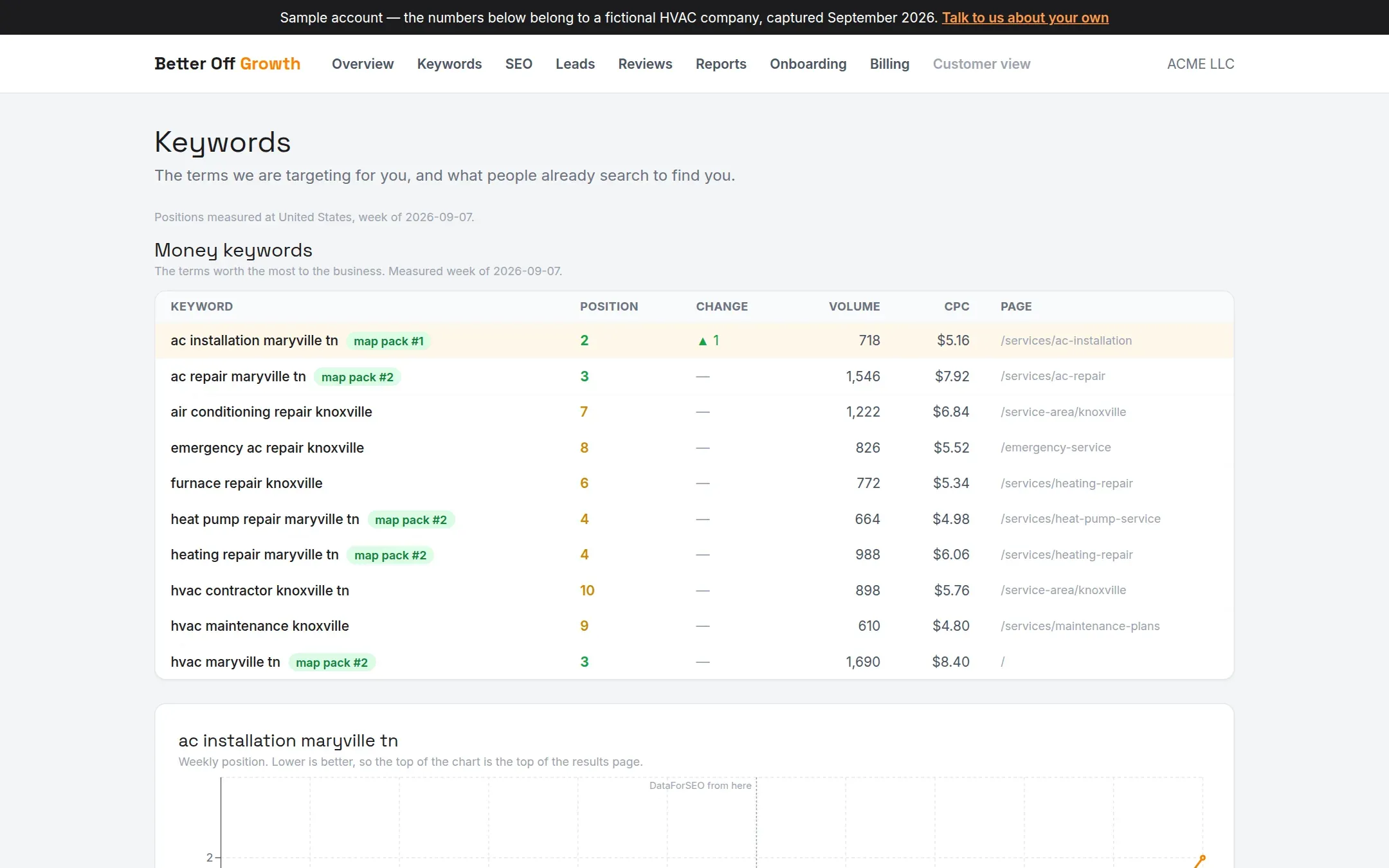
Rankings checked
Weekly every tracked term
A content campaign runs in six steps
Every campaign runs the same way, whatever the business. The research changes; the order does not.
-
Step 1: What pays, and who buys it
I start with your business, not a keyword list: which services carry the margin, where your customers are, what your site already has, and where each page ranks today.
-
Step 2: What people search, and what Google shows them
The searches you already appear for but nobody clicks, how many people search each term in your market, and a read of the pages that rank today, including Google's AI answer and the questions listed under it.
-
Step 3: One main page and the questions around it
The main page is the one that should win the search where people are ready to hire. The articles around it each answer one question that page only touches, and link back to it. A page that already ranks gets rebuilt on its own address, because moving it throws the ranking away.
Article 1
One question, answered
Article 2
One question, answered
Article 3
One question, answered
Article 4
One question, answered
Main page
Your service page
Wins the search where people are ready to hire
Every article links back to the main page. -
Step 4: A rankings brief you sign off on
In plain language: what ranks today, what could, which page leads, which articles to write and in what order, and what I need from you. Nothing gets written until you have read it and chosen.
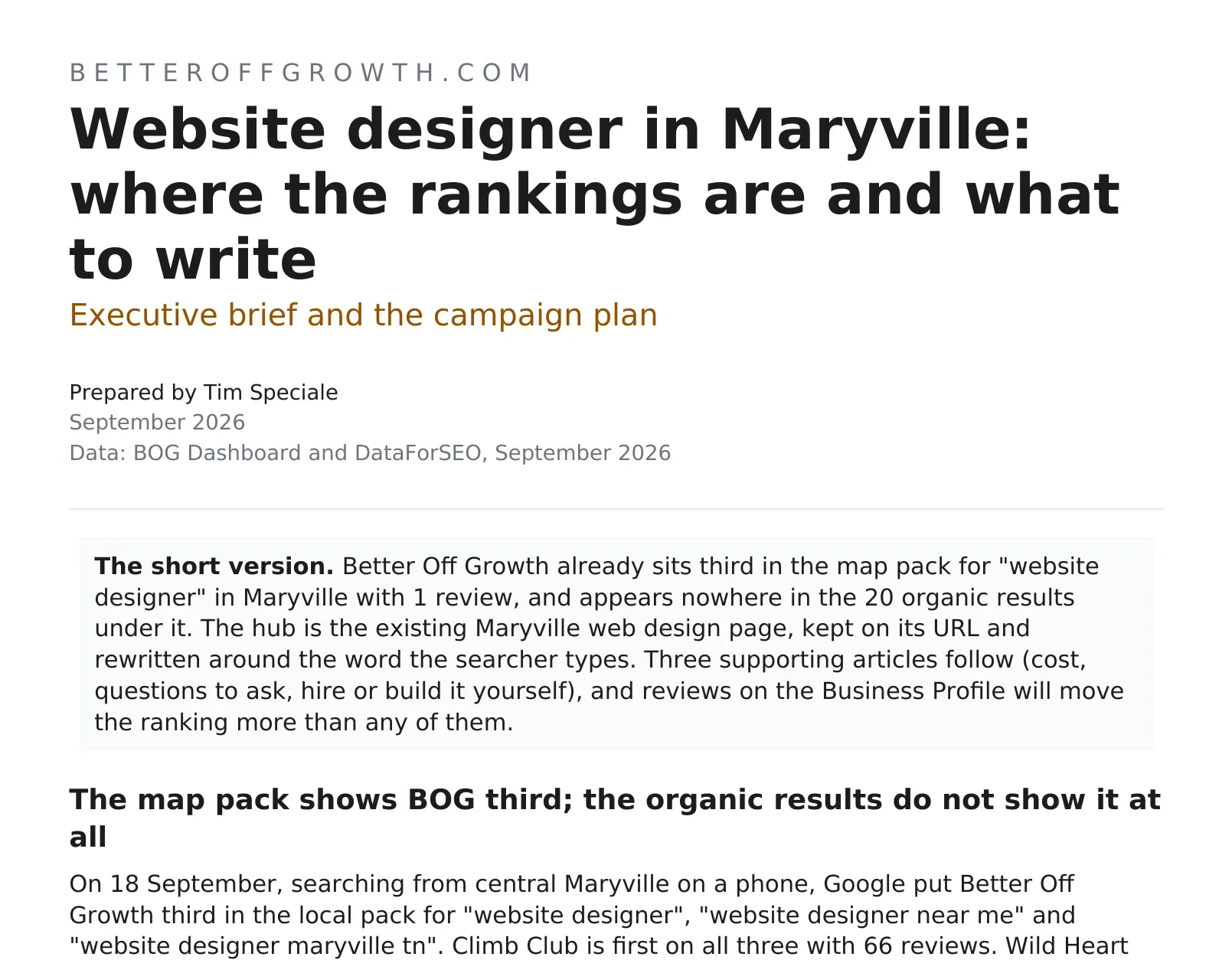
The rankings brief from our own campaign for "website designer" in Maryville. -
Step 5: A brief and outline for every article
The searches it goes after with their monthly numbers, what the top results have and what they are missing, what this page does that they do not, and one line per section on what goes there. Anything only you know, like a price or a typical job, is marked as a question for you, never guessed.
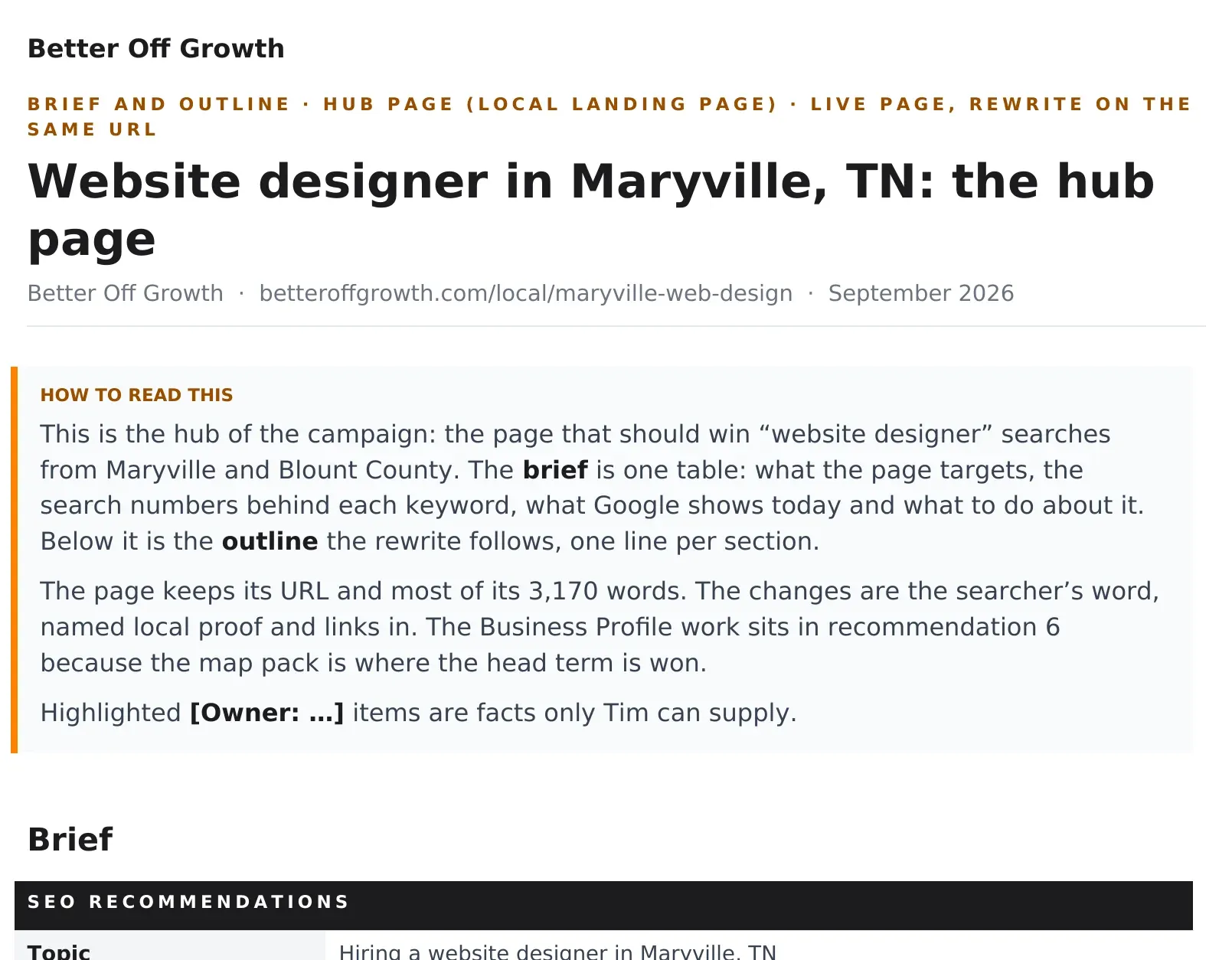
One article brief from the same campaign, for the page that should win the search. -
Step 6: Written, published and measured
I write from the approved outline and you give it a final read. It goes live linked from the pages around it, and your monthly report shows how it is doing: where it ranks, the clicks it gets, and the leads that start on it.
Every number in a brief has a source and a date
Search volumes come from Google's own data, rankings from a weekly check of the results page, and what people already search for your site from your Search Console. When a brief says a term gets 70 searches a month in your market, it says where that came from and when.
If a number cannot be traced, it does not go in the brief. The same goes for any claim on the finished page.
One row of a brief
- Search
- ac repair maryville tn
- Searches a month
- 1,546 Google search volume, September 2026
- Position today
- 3 Weekly results-page check, week of Sept 7
- Ranking page
- /services/ac-repair Search Console
A local business can write what national sites cannot
For most questions your customers ask, the top results are national publishers, software companies and forums. None of them know what the job costs in your county, which town has which rule, or what your crew sees on a typical call.
One question, two pages: "How much does a retaining wall cost?"
A national page can say
- A national average price range
- Materials listed by type
- Advice to get three quotes
Your page can say
- What the job runs in your county, from your own jobs
- Which towns need a permit, and at what wall height
- What your crew finds on a typical call, like clay soil or runoff from the lot above
- Photos of walls you built
Each brief names that gap for its article, and the page is built around it. It is also what gets a small business cited in Google's AI answers, which lean on specific, first-hand detail.
Frequently asked questions
01 What is the difference between this and local SEO?
02 How many articles are in a campaign?
03 Do I have to write anything?
04 How long before it shows up on Google?
05 Does this help with ChatGPT and Google's AI answers?
06 Is this in the Foundations plan?
Want the map results as well? See what the local SEO work includes. Every client can follow the rankings in their own client dashboard.